

Westfield's booming business corridor along U.S. 31 is attracting advanced manufacturers, tech firms, and life-science companies at a remarkable pace. With that growth comes a rapidly expanding digital attack surface. This guide walks you through how to evaluate, engage, and get the most from a cybersecurity audit—tailored specifically for the Westfield and Hamilton County business environment.
Why 2026 Is a Pivotal Year for Indiana Cybersecurity Compliance
Indiana's regulatory landscape shifted significantly at the start of this year. The Indiana Consumer Data Protection Act (ICDPA) became a legal obligation for thousands of businesses as of January 1, 2026, granting residents new rights over their personal data and empowering the Attorney General to pursue fines of up to $7,500 per violation. If your Westfield business processes data from Indiana residents at scale, you may already be in scope.
On top of the ICDPA, Senate Enrolled Act 472 added mandatory cybersecurity policies and incident reporting requirements for state agencies, political subdivisions, and school systems. Businesses that contract with any of these entities now carry vendor obligations under SEA 472 as well—an especially relevant consideration in a city like Westfield that works closely with public institutions and Grand Park operations.
Meanwhile, Indiana's Data Breach Notification Law requires businesses to notify affected individuals without unreasonable delay after discovering a breach involving personal information, and the Indiana Attorney General must also be notified if more than 500 residents are impacted. A cybersecurity audit is the most reliable way to confirm you can meet those obligations before an incident occurs.
What a Cybersecurity Audit Actually Evaluates
A cybersecurity audit is a systematic evaluation of an organization's security policies, systems, and controls. It assesses how well a company's data is protected by identifying vulnerabilities, compliance gaps, and areas for improvement. Here are the core domains a thorough audit should cover:
- Asset Discovery & Inventory — Cataloging every device, cloud instance, and SaaS application in your environment. Many businesses overlook IoT devices like smart thermostats, security cameras, and point-of-sale terminals.
- Vulnerability Assessment — Scanning internet-facing systems first, then internal networks, for known exploits. Findings are ranked by severity so you can prioritize remediation.
- Access Control Review — Evaluating password policies, multi-factor authentication adoption, and role-based permissions. Weak authentication remains a common weak link, especially with remote work.
- Data Flow Mapping — Tracing how personal and sensitive information moves through your organization, which is critical for ICDPA compliance and for meeting Data Protection Impact Assessment requirements for high-risk processing activities.
- Incident Response Readiness — Testing whether your team can detect, contain, and report a breach within Indiana's required timelines.
- Backup & Recovery Verification — Confirming that backups are tested, off-site, and recoverable—essential protection against the growing wave of ransomware attacks that lock systems and demand payment.
- Vendor & Third-Party Risk — Assessing the security posture of your technology vendors, because cybersecurity is a shared responsibility across the entire organization—including external partners.
Step-by-Step: How to Choose the Right Auditor for Your Westfield Business
Step 1 — Define Your Audit Scope
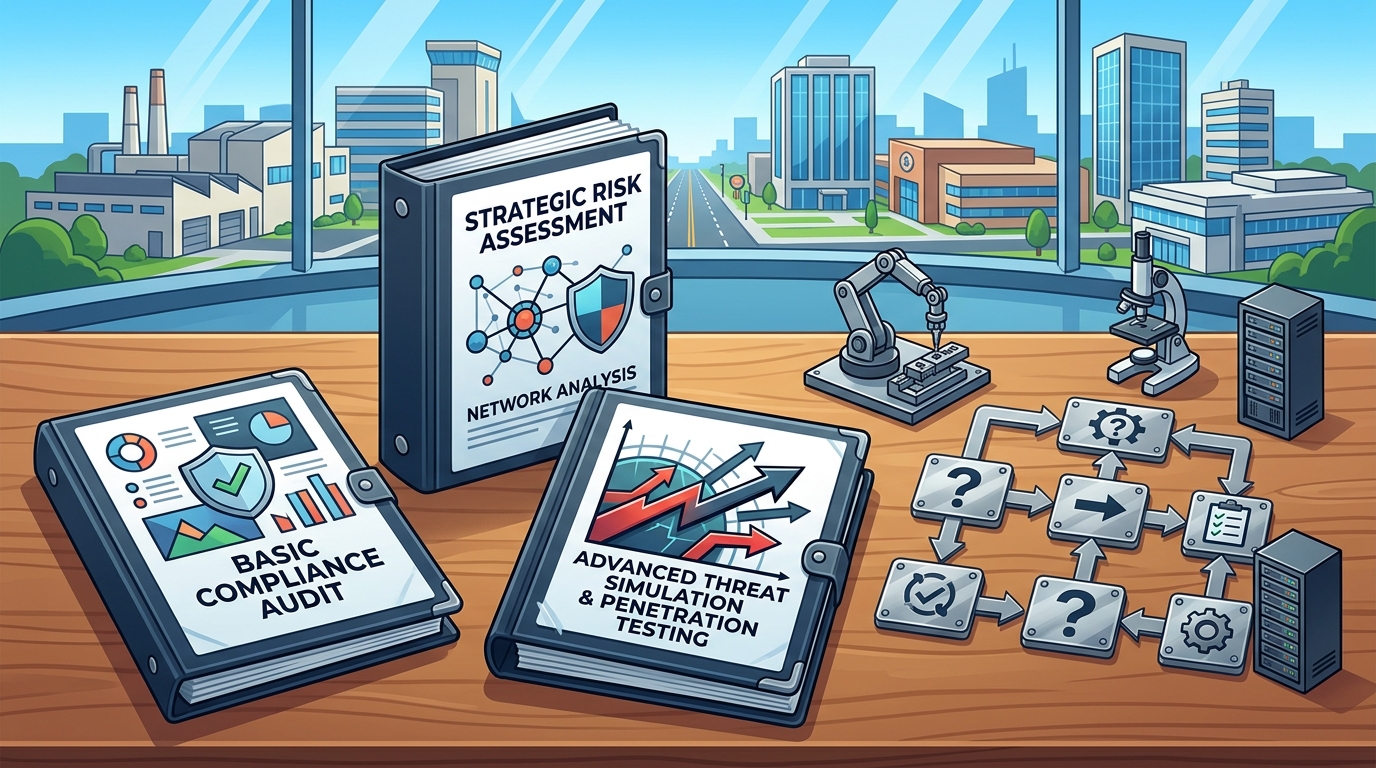
Before contacting any provider, determine what triggers the audit. Are you pursuing a specific compliance certification (SOC 2, ISO 27001, HIPAA)? Responding to a client's security questionnaire? Or conducting a general health check? The scope dictates whether you need a full-spectrum audit or a targeted assessment.
Step 2 — Decide Between Local, Regional, and National Firms
Westfield sits within the greater Indianapolis metro, giving you access to a deep bench of cybersecurity firms. Local and regional providers understand Indiana's specific regulatory nuances and can provide faster, more contextual responses to critical issues. National firms may offer broader certification capabilities but can lack the Midwest-specific regulatory knowledge that matters for ICDPA and SEA 472 compliance.
Step 3 — Verify Certifications and Accreditations
Look for auditors whose engineers hold recognized certifications such as CISSP, CISA, CEH, or OSCP. If you need a formal compliance audit (e.g., SOC 2 Type II), confirm the firm is licensed to issue those reports. Many Indiana businesses across manufacturing, energy, and logistics sectors adopt the NIST Cybersecurity Framework—make sure your auditor has demonstrated experience mapping controls to that framework.
Step 4 — Evaluate Their Audit Methodology
A quality auditor should present a clear methodology before engagement. Ask for a sample audit plan that includes timelines, deliverables, and how findings will be prioritized. Specialized security capabilities like Endpoint Detection and Response (EDR) analysis are now considered essential for identifying lateral movement within compromised environments.
Step 5 — Assess Post-Audit Support
The audit report is only valuable if you act on its findings. Ask whether the firm provides remediation guidance, re-testing, or ongoing managed security services. Some providers offer virtual CISO (vCISO) services that give you on-demand strategic security leadership without the cost of a full-time hire.
The Westfield Business Landscape and Its Unique Cyber Risks
Westfield has been recognized as the fastest-growing community in Indiana, with the city proactively targeting opportunities in advanced manufacturing, technology, and sports business. Companies like SEP (software development), Taranis (ag-tech AI), Abbott (manufacturing), and Bastian Solutions (robotics and automation) have established or expanded operations in the city.
This diverse economic profile creates a varied threat model. Manufacturers face intellectual property theft and supply-chain attacks—data from CISA shows that manufacturing and logistics sectors in the Great Lakes region are primary targets for ransomware groups. Tech firms handling customer data face ICDPA obligations and client-driven compliance requirements. Sports and hospitality businesses around Grand Park process high volumes of payment card data, making PCI DSS compliance a priority.
Midwest businesses in 2026 also face a sharp rise in AI-driven phishing and targeted supply-chain disruptions. Attackers are using automation and artificial intelligence to breach systems, and they often stay hidden for weeks or months before launching an attack. A cybersecurity audit tailored to your specific industry vertical is far more effective than a generic checklist approach.
Free Indiana Resources to Supplement Your Audit
Before or after your formal audit, take advantage of state-provided resources:
- Indiana Cybersecurity Hub (in.gov/cybersecurity) — The Indiana Small Business Development Center provides ready-to-use resources to help avoid or reduce the impact of cyber incidents.
- GCA Cybersecurity Toolkit — A no-cost resource for small business owners to improve their security posture.
- Indiana Privacy Toolkit — Released by the Indiana Executive Council on Cybersecurity (IECC), this step-by-step guide is tailored to fit the needs of small businesses, nonprofits, and local government.
- PII Guidebook 2.0 — Updated by the IECC Privacy Working Group to help Indiana businesses understand what constitutes personally identifiable information and what requires heightened protection.
What Does a Cybersecurity Audit Cost—and What's the ROI?
Audit costs vary widely based on scope, company size, and compliance requirements. A basic vulnerability assessment for a 10-person Westfield office might run $2,000–$5,000. A comprehensive SOC 2 or HIPAA readiness audit for a mid-size firm could range from $15,000–$50,000 or more.
Consider the alternative: the average cost of a data breach in the United States reached $4.88 million according to the 2024 IBM Cost of a Data Breach Report. Industry estimates suggest proactive cybersecurity investments yield a strong ROI, with businesses saving up to $7 in breach recovery costs for every dollar spent on prevention. For a small business, a single ransomware attack can mean complete operational shutdown—making the audit investment modest by comparison.
Key Takeaways
- Indiana's ICDPA took effect January 1, 2026—if your Westfield business handles Indiana resident data at scale, a cybersecurity audit should be your first compliance step.
- Choose an auditor with Indiana-specific regulatory knowledge, verified certifications, and a clear methodology that maps to frameworks like NIST CSF.
- Tailor your audit to Westfield's diverse industry profile: manufacturing IP protection, healthcare HIPAA, payment card PCI DSS, or tech-sector SOC 2.
- Leverage free state resources from the Indiana Cybersecurity Hub and IECC toolkits to supplement your professional audit.
- Post-audit remediation planning and ongoing vCISO support turn a one-time assessment into a continuous security improvement program.
Frequently Asked Questions
- How often should my Westfield business conduct a cybersecurity audit?
- At minimum, annually. However, you should also audit after major infrastructure changes, mergers, new compliance requirements (like the ICDPA), or following any security incident. Many compliance frameworks require annual reassessment.
- Does my small business really need a cybersecurity audit?
- Yes. Small and medium businesses are now a major target for cybercriminals because they often have weaker defenses. A single cyberattack can lead to financial losses, legal issues, and long-term reputation damage. Indiana ranked second in the nation for cybercrime complaints per capita in 2024.
- What is the difference between a vulnerability assessment and a full cybersecurity audit?
- A vulnerability assessment focuses on scanning systems for known technical weaknesses. A full cybersecurity audit is broader—it evaluates policies, procedures, access controls, employee training, compliance posture, and incident response readiness in addition to technical vulnerabilities.
- Can a managed IT provider also perform my cybersecurity audit?
- They can, but there is an inherent conflict of interest when the same firm that manages your systems also audits them. Many organizations prefer to engage an independent third party for the audit while keeping their MSP for day-to-day operations. At minimum, ensure your auditor has specialized cybersecurity personnel rather than general help-desk staff.
- What Indiana-specific laws affect my cybersecurity obligations?
- Key laws include the Indiana Consumer Data Protection Act (ICDPA), Indiana's Data Breach Notification Law, Senate Enrolled Act 472 for public-sector contractors, and federal regulations like HIPAA, SOX, PCI DSS, and the NIST framework depending on your industry.
- How does Maranatha Tech Solutions help with cybersecurity audits?
- Maranatha Tech Solutions provides cybersecurity assessment and consulting services tailored to Westfield and Hamilton County businesses. We help you identify gaps, prioritize remediation, and build a compliance-ready security posture aligned with Indiana regulations and industry frameworks. Contact us for a consultation.