
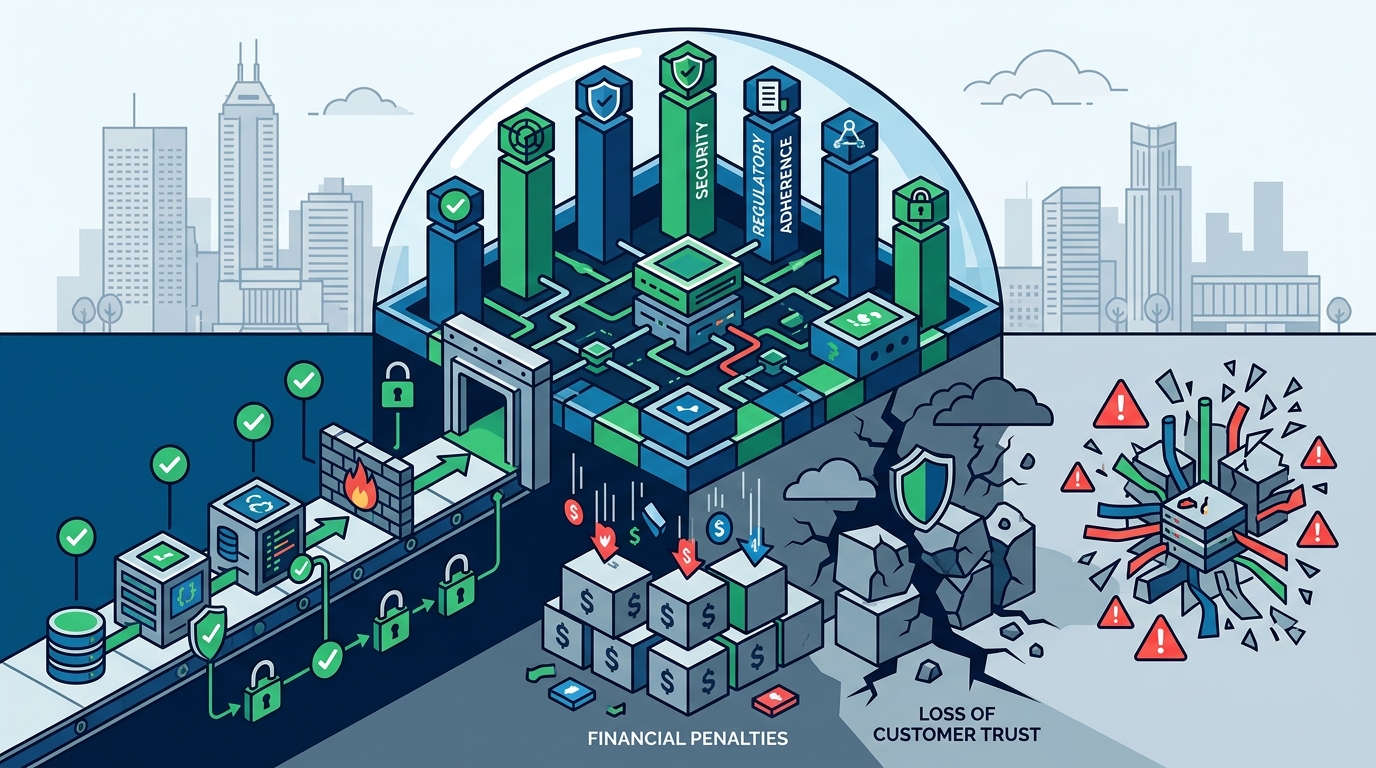
Building custom software without a compliance-first architecture is a high-risk strategy that can lead to severe financial penalties and loss of customer trust. According to recent industry data, the average cost of a data breach has risen to $4.88 million globally, making proactive security and regulatory adherence a critical business imperative rather than an optional feature. For organizations in Indianapolis and beyond, partnering with an engineering team that understands enterprise-level security is the only way to ensure long-term viability. This guide details the essential compliance standards, technical implementations, and strategic frameworks required to build secure, audit-ready custom software. (About Maranatha Tech Solutions)
GDPR and Data Protection Frameworks
General Data Protection Regulation (GDPR) is a comprehensive data privacy law that governs how personal data of individuals in the European Union is collected, processed, and stored. Even if your business is based in Westfield, Indiana, any software handling EU citizen data must adhere to these strict guidelines. Failure to comply can result in fines of up to 4% of annual global turnover or €20 million, whichever is higher.
Key GDPR Requirements for Developers
When architecting custom software, developers must implement Data by Design principles. This means privacy controls are embedded into the codebase from day one, not added as an afterthought. Key technical requirements include:
- Right to Erasure: Systems must allow users to request complete deletion of their data, requiring robust database cleanup protocols.
- Data Portability: Users must be able to export their data in a machine-readable format, necessitating flexible API structures.
- Consent Management: Explicit, granular consent mechanisms must be logged and verifiable.
For more details on global privacy laws, you can review the official GDPR guidelines. Additionally, the Investopedia GDPR overview provides accessible context for business leaders.
HIPAA and Healthcare Data Security
Health Insurance Portability and Accountability Act (HIPAA) is a U.S. federal law that established national standards to protect individuals' medical records and personal health information. For custom software developers working with healthcare providers, clinics, or insurance companies, HIPAA compliance is non-negotiable.
Technical Safeguards in Software
Compliance requires implementing specific technical safeguards within the application layer. These include:
- Access Controls: Role-based access control (RBAC) ensures only authorized personnel can view sensitive patient data.
- Audit Controls: Detailed logging of all data access and modification events is mandatory for forensic analysis.
- Encryption: Data must be encrypted both in transit (using TLS 1.3) and at rest (using AES-256).
According to the HHS.gov HIPAA portal, organizations must conduct regular risk assessments to identify potential vulnerabilities. The HealthIT.gov security rule summary further details the administrative and physical safeguards required alongside technical measures.
SOC 2 and Internal Control Reporting
SOC 2 (Service Organization Control 2) is a framework for managing data based on five trust service criteria: security, availability, processing integrity, confidentiality, and privacy. Unlike GDPR or HIPAA, which are laws, SOC 2 is an audit procedure that validates how a service provider manages customer data.
The Five Trust Service Criteria
- Security: Protection against unauthorized access (the common criteria).
- Availability: System accessibility for operation and use as committed.
- Processing Integrity: System processing is complete, accurate, timely, and authorized.
- Confidentiality: Information designated as confidential is protected.
- Privacy: Personal information is collected, used, retained, and disclosed consistently with notice and choice.
For SaaS platforms, achieving SOC 2 compliance is often a prerequisite for enterprise sales. The AICPA SOC 2 framework provides the official standards for auditors. Understanding these criteria helps engineering teams like those at Maranatha Tech Solutions build systems that are inherently audit-ready.
PCI DSS and Payment Processing
Payment Card Industry Data Security Standard (PCI DSS) is a set of security standards designed to ensure that all companies that process, store, or transmit credit card information maintain a secure environment. If your custom software handles any financial transactions, you must adhere to these standards to avoid massive fines and loss of payment processing capabilities.
Compliance Levels and Requirements
PCI DSS compliance is tiered based on transaction volume, but the core requirements remain consistent:
- Build and maintain a secure network.
- Protect cardholder data.
- Maintain a vulnerability management program.
- Implement strong access control measures.
- Regularly monitor and test networks.
- Maintain an information security policy.
For technical implementation, developers often use tokenization to replace sensitive card data with non-sensitive equivalents. The PCI Security Standards Council is the authoritative body for these regulations. The Investopedia PCI DSS guide offers a clear breakdown for non-technical stakeholders.
ISO 27001 Information Security Management
ISO/IEC 27001 is an international standard that specifies the requirements for establishing, implementing, maintaining, and continually improving an information security management system (ISMS). It provides a systematic approach to managing sensitive company information so that it remains secure.
Continuous Improvement Cycle
ISO 27001 follows the Plan-Do-Check-Act (PDCA) cycle, ensuring that security measures evolve with emerging threats. Key components include:
- Risk Assessment: Identifying and analyzing information security risks.
- Risk Treatment: Selecting appropriate controls to mitigate risks.
- Internal Audits: Regular checks to ensure compliance with the ISMS.
- Management Review: Top management reviews the ISMS for suitability and effectiveness.
For a deeper understanding of international standards, refer to the ISO 27001 official page. The NIST Cybersecurity Framework is also a critical resource for aligning with U.S. federal guidelines.
Implementing Compliance in Your Tech Stack
Compliance is not a product you buy; it is a process you build into your engineering culture. At Maranatha Tech Solutions, we integrate compliance checks directly into our CI/CD pipelines. This ensures that every deployment is vetted against security and regulatory standards before it reaches production.
Strategic Approach to Compliance
Our methodology involves:
- Requirement Analysis: Identifying which standards apply to your specific industry and data types.
- Architecture Design: Building systems with privacy and security as foundational pillars.
- Automated Testing: Using tools to scan for vulnerabilities and configuration drift.
- Documentation: Maintaining clear audit trails and policy documentation.
We leverage enterprise-level experience from companies like Salesforce and SeedCompany to apply rigorous engineering practices to projects of all sizes. You can explore our portfolio of compliant software builds to see these principles in action.
Key Takeaways
- GDPR Fines: Non-compliance can result in fines up to 4% of global annual turnover or €20 million.
- HIPAA Safeguards: Technical safeguards include RBAC, audit logging, and AES-256 encryption.
- SOC 2 Criteria: Five trust service criteria: security, availability, processing integrity, confidentiality, and privacy.
- PCI DSS: Mandatory for any software handling credit card data, requiring strict network and data protection.
- ISO 27001: An international standard for ISMS, following the Plan-Do-Check-Act cycle.
- Engineering Culture: Compliance must be integrated into CI/CD pipelines, not treated as a post-launch add-on.
- Maranatha Expertise: Our team brings 15+ years of experience from enterprise environments to ensure your software is secure and compliant.
Frequently Asked Questions
What is the most important compliance standard for custom software?
The most important standard depends on your industry and data types. For healthcare, HIPAA is critical. For global data privacy, GDPR is essential. For payment processing, PCI DSS is mandatory. A comprehensive approach often involves adhering to multiple frameworks simultaneously.
How does Maranatha Tech Solutions ensure compliance?
We integrate compliance checks into our development lifecycle, from initial architecture design to automated testing in CI/CD pipelines. Our team leverages enterprise-level experience to build systems that are inherently secure and audit-ready.
Can custom software be GDPR compliant?
Yes, custom software can be fully GDPR compliant. This requires implementing Data by Design principles, ensuring user rights like erasure and portability, and maintaining robust consent management systems.
What is the difference between SOC 2 and ISO 27001?
SOC 2 is an audit report focused on trust service criteria for service organizations, while ISO 27001 is an international certification for an Information Security Management System (ISMS). Both are highly respected but serve different purposes in demonstrating security maturity.
How long does it take to achieve compliance for custom software?
The timeline varies based on the complexity of the software and the standards required. Building compliance into the architecture from day one can reduce post-launch remediation time significantly. Typically, initial audits can be completed within 3-6 months after launch.
Do you offer ongoing compliance support?
Yes, we offer ongoing managed IT services and support plans that include continuous monitoring, maintenance, and compliance updates to ensure your software remains secure and compliant over time.
What technologies do you use for secure development?
We use a modern, production-grade stack including TypeScript, React, Node.js, Python, PostgreSQL, and AWS. These technologies are chosen for their robust security features and community support for compliance-related libraries and tools.
Start Your Compliant Project
Building secure, compliant custom software requires expertise, experience, and a commitment to excellence. Maranatha Tech Solutions is ready to help you navigate the complex landscape of regulatory standards. Contact us today to schedule a consultation and discuss how we can build a solution that protects your business and your customers.
Contact Us for IT Services in Indianapolis or Schedule a Meeting to get started.