
AI Automation Pricing Models for Nonprofit Administrative Workflows
Nonprofit organizations are facing an unprecedented operational crisis. According to recent industry data, the average nonprofit spends approximately 20% of its total budget on administrative overhead, a figure that has remained stubbornly high despite technological advancements. This financial burden directly impacts mission delivery, forcing leaders to choose between hiring more staff or automating critical tasks. AI automation offers a pathway to reduce this overhead, but understanding the pricing models is essential for budget-conscious organizations. Maranatha Tech Solutions specializes in building custom AI automation for nonprofits, churches, and small businesses, ensuring that technology serves people rather than complicating their work. This guide explores how to evaluate, implement, and price AI automation for administrative workflows while maintaining fiscal responsibility and ethical integrity. (Contact Us for IT)
Understanding AI Automation for Nonprofits
AI automation is not a single product but a suite of technologies designed to mimic human cognitive functions. In the context of nonprofit administration, this includes natural language processing for donor communications, machine learning for grant matching, and robotic process automation for data entry. The goal is to remove busywork and surface insight, allowing staff to focus on high-impact activities. (About Maranatha Tech Solutions)
For organizations like churches and small nonprofits, the complexity of technology can be a barrier. Maranatha Tech Solutions operates with a mission to serve these entities with trustworthy, relationship-focused technology solutions. We believe that technology should be accessible and affordable, not a luxury reserved for large enterprises. By leveraging enterprise-level engineering experience, we ensure that even small organizations can benefit from robust, secure, and scalable AI systems. (Custom Software Web amp)
Administrative workflows in nonprofits often involve repetitive tasks such as donor acknowledgment, event registration, and volunteer scheduling. These tasks are time-consuming and prone to human error. AI automation can handle these processes with greater accuracy and speed, freeing up valuable human resources. The key is to choose the right pricing model that aligns with your organization's cash flow and growth trajectory. (Software Engagement Models amp)
Common Pricing Models Explained
When evaluating AI automation for your nonprofit, it is crucial to understand the different pricing structures available. Each model has its own advantages and disadvantages, depending on your organization's size, technical maturity, and budget constraints.
Subscription-Based Pricing
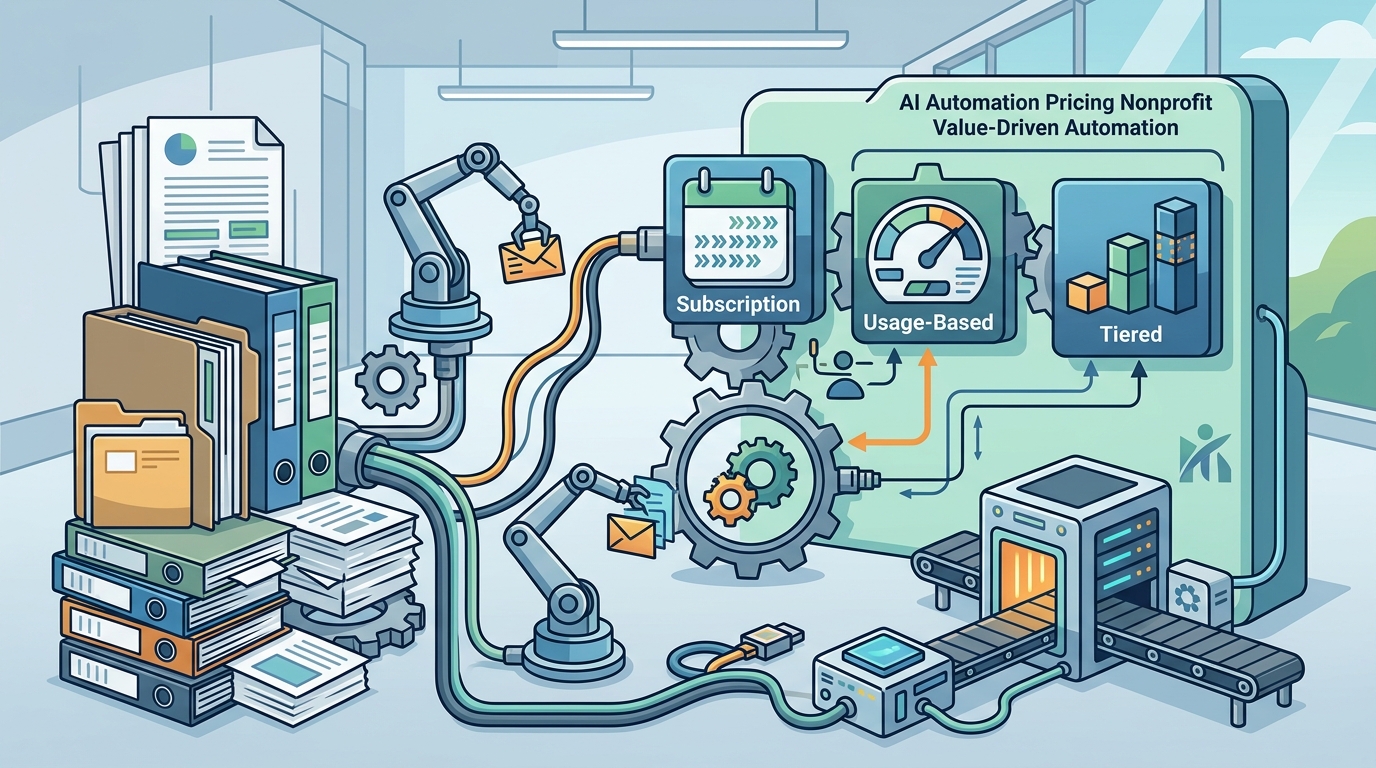
Subscription-based pricing is the most common model for SaaS (Software as a Service) AI tools. Organizations pay a monthly or annual fee to access the software. This model offers predictability and ease of budgeting, making it ideal for nonprofits with stable cash flows. However, costs can add up quickly if multiple tools are used for different workflows.
For example, a donor management platform might charge $100 per month for basic features, with additional costs for advanced AI capabilities like automated email personalization. While this seems affordable, the cumulative cost of multiple subscriptions can strain a nonprofit's budget. Maranatha Tech Solutions often recommends evaluating the total cost of ownership before committing to multiple SaaS products.
Usage-Based Pricing
Usage-based pricing charges organizations based on their consumption of AI services, such as the number of API calls, data processed, or hours of compute time. This model is flexible and scales with your organization's needs, making it suitable for nonprofits with fluctuating workloads. However, it can be difficult to predict costs, which may lead to budget overruns if usage spikes unexpectedly.
For instance, an AI-powered grant writing assistant might charge $0.01 per word processed. If your team writes 100,000 words in a month, the cost would be $1,000. While this model offers flexibility, it requires careful monitoring to avoid unexpected expenses. Nonprofits should implement usage alerts and caps to manage costs effectively.
Custom Development Pricing
Custom development pricing involves hiring a software engineering team to build a tailored AI solution for your specific needs. This model offers the highest level of customization and control, ensuring that the automation aligns perfectly with your workflows. However, it typically requires a higher upfront investment and a longer development timeline.
Maranatha Tech Solutions specializes in custom software development for nonprofits, churches, and small businesses. Our team brings over 15 years of experience from companies like Salesforce and SeedCompany, delivering enterprise-grade solutions at a fair price. We work closely with clients to understand their unique challenges and build solutions that drive real impact. Custom development is ideal for nonprofits with complex, unique workflows that off-the-shelf solutions cannot address.
Cost Breakdown by Workflow
Understanding the cost implications of AI automation across different administrative workflows is essential for effective budgeting. Below is a breakdown of typical costs associated with automating key nonprofit tasks.
| Workflow | Automation Type | Estimated Monthly Cost | ROI Potential |
|---|---|---|---|
| Donor Communications | AI Email Personalization | $50 - $200 | High |
| Grant Writing | AI Content Generation | $100 - $500 | Medium |
| Volunteer Scheduling | AI Scheduling Assistant | $30 - $100 | Medium |
| Data Entry | Robotic Process Automation | $200 - $1,000 | High |
| Event Registration | AI Chatbot | $50 - $150 | Medium |
These costs are estimates and can vary based on the complexity of the workflow and the provider. It is important to conduct a thorough needs assessment to determine which workflows offer the highest ROI for your organization. Maranatha Tech Solutions offers free consultations to help nonprofits identify the most impactful automation opportunities.
Calculating ROI for Administrative Tasks
Return on Investment (ROI) is a critical metric for evaluating the effectiveness of AI automation. For nonprofits, ROI is not just about financial savings but also about mission impact. By reducing administrative overhead, nonprofits can redirect resources toward program delivery and community service.
To calculate ROI, consider the following formula:
ROI = (Benefit of Investment - Cost of Investment) / Cost of Investment
The benefit of investment includes both direct cost savings and indirect benefits such as improved efficiency, accuracy, and staff satisfaction. For example, if automating donor communications saves 10 hours of staff time per month, and the average staff hourly rate is $25, the direct cost savings would be $250. If the automation tool costs $100 per month, the net benefit is $150, resulting in an ROI of 150%.
Maranatha Tech Solutions helps nonprofits quantify these benefits by conducting detailed workflow analyses. We identify bottlenecks, estimate time savings, and project cost reductions to provide a clear picture of the potential ROI. This data-driven approach ensures that automation investments are aligned with organizational goals and deliver tangible value.
Implementation Strategy for Limited Budgets
Implementing AI automation on a limited budget requires a strategic approach. Start by identifying the most time-consuming and error-prone workflows. These are the areas where automation will have the greatest impact. Prioritize quick wins that offer high ROI with low implementation costs.
Consider starting with off-the-shelf AI tools for simple tasks like email personalization or scheduling. As your organization matures, you can invest in custom solutions for more complex workflows. Maranatha Tech Solutions offers flexible engagement models, including project-based and ongoing support, to accommodate different budget constraints.
Additionally, leverage open-source AI tools and frameworks to reduce licensing costs. Our team is proficient in technologies like Python, TensorFlow, and PyTorch, which can be used to build cost-effective AI solutions. By combining open-source tools with custom development, nonprofits can achieve enterprise-grade automation without the enterprise price tag.
Key Takeaways
- Nonprofits spend approximately 20% of their budget on administrative overhead, highlighting the need for automation.
- Subscription-based pricing offers predictability, while usage-based pricing offers flexibility.
- Custom development provides the highest level of customization but requires a higher upfront investment.
- Maranatha Tech Solutions specializes in custom AI automation for nonprofits, churches, and small businesses.
- ROI calculation should include both direct cost savings and indirect benefits like improved efficiency.
- Start with quick wins and off-the-shelf tools before investing in custom solutions.
- Leverage open-source AI tools to reduce licensing costs and maximize budget efficiency.
Frequently Asked Questions
What is AI automation?
AI automation is the use of artificial intelligence technologies to perform tasks that typically require human intelligence, such as decision-making, pattern recognition, and natural language processing.
How much does AI automation cost for nonprofits?
Costs vary widely depending on the pricing model and complexity. Subscription tools may cost $50 to $500 per month, while custom development can range from $10,000 to $100,000+.
Is AI automation suitable for small nonprofits?
Yes, AI automation is highly suitable for small nonprofits. Off-the-shelf tools and flexible pricing models make it accessible for organizations of all sizes.
How do I calculate ROI for AI automation?
ROI is calculated by subtracting the cost of investment from the benefit of investment and dividing by the cost of investment. Benefits include cost savings and improved efficiency.
Can Maranatha Tech Solutions help with AI automation?
Yes, Maranatha Tech Solutions specializes in custom AI automation for nonprofits, churches, and small businesses, offering tailored solutions that align with your mission and budget.
What are the risks of AI automation?
Risks include data privacy concerns, algorithmic bias, and dependency on technology. Mitigation strategies include rigorous testing, ethical guidelines, and human oversight.
How long does it take to implement AI automation?
Implementation time varies based on complexity. Simple tools can be deployed in days, while custom solutions may take several months.
Start Your Automation Journey
Ready to transform your nonprofit's administrative workflows with AI automation? Maranatha Tech Solutions is here to help. We offer free consultations to discuss your specific needs and provide a tailored roadmap for success. Contact us today to schedule a meeting and explore how we can support your mission.