
Common Pitfalls in Hiring Custom Software Developers for Small Businesses
Small businesses often view custom software as the ultimate lever for scaling operations, yet the path to a successful build is fraught with structural and financial risks. According to industry data, nearly 70% of software projects fail to meet their original objectives due to poor planning and misaligned vendor expectations. This statistic highlights a critical reality: the technology stack is rarely the problem, but the partnership model is. For small business owners, the cost of a failed build is not just financial; it is an opportunity cost that can stall growth for months or years. Understanding these pitfalls before signing a contract is the only way to protect your capital and your vision. (Contact Us for IT)
Misaligned Technical Expertise
One of the most common pitfalls is hiring developers who excel in one area but lack the breadth required for a full-stack solution. Small businesses often need a developer who understands both the front-end user experience and the back-end data integrity. If you hire a specialist who only knows React but lacks experience with Node.js or Python, you may face integration headaches later. Enterprise-level engineering experience ensures that every layer of the application is built to work seamlessly together. (About Maranatha Tech Solutions)
Custom software is bespoke application engineering designed to solve specific business problems. Unlike off-the-shelf software, it must align perfectly with your unique workflows. When developers lack deep technical expertise in modern stacks like TypeScript or GraphQL, the resulting code becomes brittle and difficult to maintain. This leads to higher long-term costs and slower feature delivery. (Custom Software Web amp)
Furthermore, the rise of AI automation requires developers who understand how to integrate large language models (LLMs) into existing workflows. A developer who is not up-to-date with AI-native engineering may build a system that cannot easily incorporate future automation features. This forces a complete rewrite later, which is a costly mistake for small businesses with limited budgets. (Software Engagement Models amp)
Scope Creep and Budget Erosion
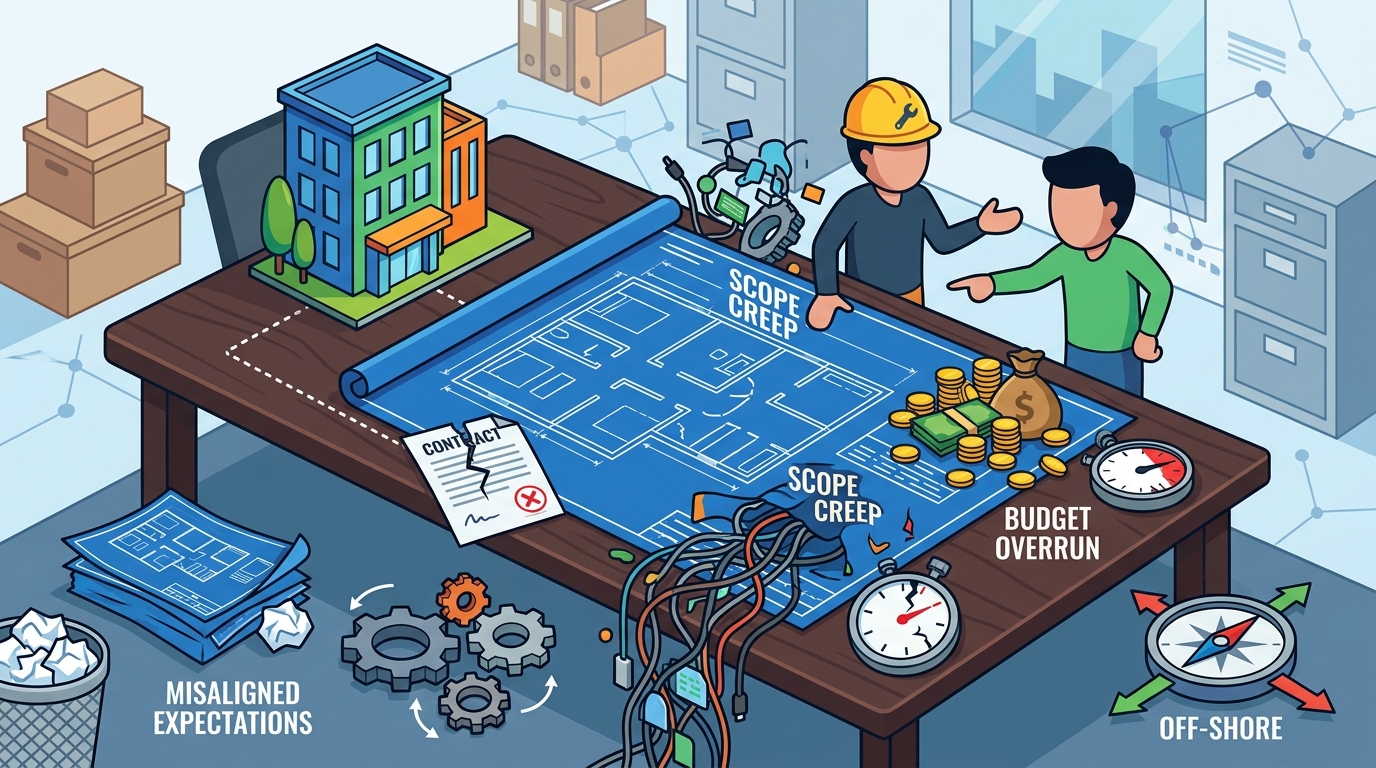
Scope creep occurs when project requirements expand beyond the original agreement without corresponding adjustments to the timeline or budget. For small businesses, this is often fatal. A project that starts as a simple web application can balloon into a complex enterprise system if boundaries are not strictly enforced. This phenomenon is well-documented in software engineering literature, where uncontrolled scope changes are cited as a primary cause of project failure.
Small businesses must define clear deliverables at the outset. This includes detailed user stories, acceptance criteria, and a fixed budget range. If a developer suggests adding features mid-project, it should trigger a formal change order process. This ensures that both parties understand the financial and temporal impact of every new requirement.
Another related pitfall is underestimating the complexity of data migration. If you are moving from legacy systems to a new custom platform, the data cleaning and mapping process can take longer than the actual development. Ignoring this phase leads to data loss or corruption, which undermines the entire purpose of the new software.
Ignoring Scalable Architecture
Many small businesses build software for their current size, not their future growth. This is a critical error. A multi-tenant SaaS architecture, for example, allows a single instance of the software to serve multiple customers, which is efficient for scaling. If you build a single-tenant system, you may need to rebuild the entire infrastructure as your user base grows.
Scalable architecture is the design of systems that can handle increased load by adding resources. It involves choosing the right cloud providers, such as AWS or GCP, and using containerization technologies like Docker and Kubernetes. These technologies ensure that your application can grow without significant re-engineering.
Additionally, database design is often overlooked. PostgreSQL is a robust choice for many applications, but it requires proper indexing and query optimization to perform well at scale. If the database is not designed correctly from the start, performance will degrade as data volume increases, leading to slow user experiences and lost revenue.
Communication Breakdown
Technical jargon can create a barrier between small business owners and developers. When developers use complex terminology without explanation, misunderstandings arise. This leads to features that do not meet the business owner's expectations. Regular, clear communication is essential to bridge this gap.
Agile methodology is a software development approach that emphasizes iterative progress and collaboration. It allows for regular feedback loops, ensuring that the product evolves in the right direction. Without agile practices, small businesses may wait months to see a working product, only to find it does not align with their needs.
Transparency in reporting is also crucial. Developers should provide regular updates on progress, challenges, and risks. This allows business owners to make informed decisions and adjust strategies as needed. A lack of transparency often leads to surprise costs and delayed timelines.
Security and Compliance Oversights
Security is not an afterthought; it must be built into the foundation of the application. Many small businesses overlook compliance requirements such as GDPR or HIPAA, which can lead to severe legal penalties. GDPR-compliant builds ensure that user data is handled according to strict European privacy standards.
Vulnerability remediation is the process of identifying and fixing security flaws in software. This includes regular code reviews, penetration testing, and secure API integration. If these steps are skipped, the application becomes an easy target for cyberattacks, which can damage your reputation and result in data breaches.
Furthermore, data encryption is essential for protecting sensitive information. Both data at rest and data in transit must be encrypted using industry-standard protocols. This protects your customers' data and builds trust in your brand. Ignoring these security measures is a significant risk that can jeopardize the entire business.
Post-Launch Abandonment
Many developers deliver the code and disappear, leaving the business owner to manage the infrastructure alone. This is a dangerous position for a small business that lacks in-house IT expertise. Ongoing maintenance, updates, and bug fixes are required to keep the software running smoothly.
Managed IT services provide continuous monitoring and support for a fixed monthly fee. This ensures that any issues are addressed quickly and proactively. Without this support, small businesses may face downtime that disrupts operations and frustrates customers.
Additionally, software evolves. New features, security patches, and compatibility updates are necessary to keep the application relevant. A partner who offers committed support will help you navigate these changes, ensuring that your investment continues to deliver value over time.
Key Takeaways
- Technical Breadth Matters: Ensure your developers have expertise in full-stack technologies like TypeScript, React, and Node.js to avoid integration issues.
- Define Scope Rigorously: Use detailed contracts and change order processes to prevent budget erosion from scope creep.
- Plan for Scale: Invest in scalable architecture and database design from day one to accommodate future growth.
- Prioritize Security: Implement GDPR-compliant builds and regular vulnerability remediation to protect against data breaches.
- Ensure Ongoing Support: Choose a partner who offers managed IT services and long-term maintenance, not just one-time development.
- Communicate Clearly: Use agile methodologies and regular reporting to maintain alignment between technical and business goals.
- Verify Experience: Look for developers with enterprise-level experience to ensure high-quality code and robust architecture.
Frequently Asked Questions
How do I prevent scope creep in my custom software project?
Prevent scope creep by defining clear deliverables and acceptance criteria in your contract. Use a formal change order process for any new features requested during development to track costs and timelines accurately.
What technical stack should I choose for a small business application?
Popular and robust stacks include TypeScript with React for the front-end and Node.js or Python for the back-end. PostgreSQL is often the best choice for the database due to its reliability and scalability.
Why is ongoing IT support important after launch?
Ongoing support ensures that your software remains secure, up-to-date, and performant. It provides immediate assistance for bugs and allows for continuous improvement based on user feedback.
How can I ensure my software is secure from the start?
Integrate security into the development lifecycle by conducting regular code reviews, using secure API practices, and implementing encryption for data at rest and in transit.
What is the difference between custom software and SaaS?
Custom software is built specifically for your business needs, while SaaS (Software as a Service) is a pre-built solution designed for a broad market. Custom software offers greater flexibility and control.
How long does it take to build custom software?
Timelines vary based on complexity, but a typical MVP (Minimum Viable Product) can take 3 to 6 months. More complex enterprise systems may take 6 to 12 months or longer.
Do I need to be technical to manage a software project?
While technical knowledge helps, it is not required. A good development partner will translate technical concepts into business terms and keep you informed throughout the process.
Start Your Project
Avoid these common pitfalls by partnering with a team that values integrity, transparency, and technical excellence. Maranatha Tech Solutions offers enterprise-level engineering with a personalized approach tailored to small businesses. We build custom software, web applications, and AI automation that are designed to last. Schedule a consultation today to discuss your vision and ensure your project starts on the right foot.